
Wantok, One Talk
Who shares your language?

The South Pacific nation of Papua New Guinea has some 600 islands and even more tongues—840 living languages, the most in the world. As it was explained to me when my Dad was posted there as a diplomat some decades ago, the terrain of PNG is so rugged, so mountainous that there is no way to travel overland south to north or east to west, no way to travel from coastal regions inland on the main island. The cost of constructing a road or railroad tracks is too prohibitive. This led to a proliferation of entirely discrete languages, not dialects but actual separate languages. Tribes or clans which may have been relatively close geographically as the crow flies were isolated from each other for thousands of years and speaking their own unique pattern of words. It is a linguist’s dream.
This reality eventually led to the word “wantok” in Tok Pisin (Pidgin English), the lingua franca of PNG. Wantok literally means “one talk,” referring to those who speak the same language, possibly only a few hundred people in the entire world. But more generally, wantok has come to take on another meaning: those with whom you share a social bond.
I have been lucky enough to find wantok all over the world, in homeless shelters, jails and, recently, in Wellington New Zealand where I met with the team who work at Arts Access Aotearoa (Aotearoa is the original name of the land as spoken by its Indigenous people). The organization seeks to increase access to the arts in New Zealand among different communities, including among individuals who are incarcerated in one of the country’s 18 prisons.
Not long before I was scheduled to visit, Neil Wallace, the Arts in Corrections Advisor for the organization emailed me that he and his colleagues would be performing a mihi whakatau, “a formal yet gentle welcome used in Māori culture, especially in office or public settings. It’s a shorter version of a traditional welcoming ceremony, often used to respectfully receive visitors. It marks your arrival with care and intention.” This ceremony, Neil wrote was “a way to honour who you are, the kaupapa (purpose or guiding principle) that brings you here, and to signal that you are not just entering a physical space but joining us in a shared journey.”
The mihi whakatau was unlike anything I had ever experienced before. The Executive Director of Arts Access Aotearoa, Richard Benge, offered the mihi (speech of welcome) which acknowledged, among other things, “the kaupapa [philosophy] that links us.” Richard ended the speech, which had been delivered entirely in te reo Māori (the Māori language), with:
Nau mai, whakatau to whakatau mai rā ki a mātou katoa i tēnei kaupapa o tēnei ra.
Which means, “Welcome, be at ease and join with us in today’s shared purpose.” I had found new wantok.
In a way, I suppose “wantok” could be related to the reo Māori word whakapapa which refers to genealogy or ancestral lineage. “Whakapapa is not just a list of names or a diagram on a wall,” Neil wrote in a post on the Arts Access Aotearoa website. “It is a living relationship that connects us to our ancestors, to place and to one another.”
And for people who are in prison, he wrote, “whakapapa – our genealogy and history – offers a way back to belonging. It helps people remember who they are, not just what they have done.” It is, he says “a foundation for rehabilitation” and, thus, potentially transformational.
Like some minority populations in the U.S., the Māori people are significantly overrepresented in New Zealand’s correctional system—a situation closely tied to the long-term effects of colonization, inequality, and systemic barriers. Arts in corrections programs provide “space where arts and culture are intertwined, particularly in te ao Māori [Māori worldview],” Neil explained. “Through visual arts, weaving, music, theatre, carving, and the written and spoken word, we have the tools for people to explore and express their whakapapa.”
That journey is best supported by people who have themselves hewed this road, Neil wrote in his post. Neil, who traces his lineage to Māori ancestors, believes that the nation needs more Māori outside who can help guide justice-involved Māori in discovering their own whakapapa.
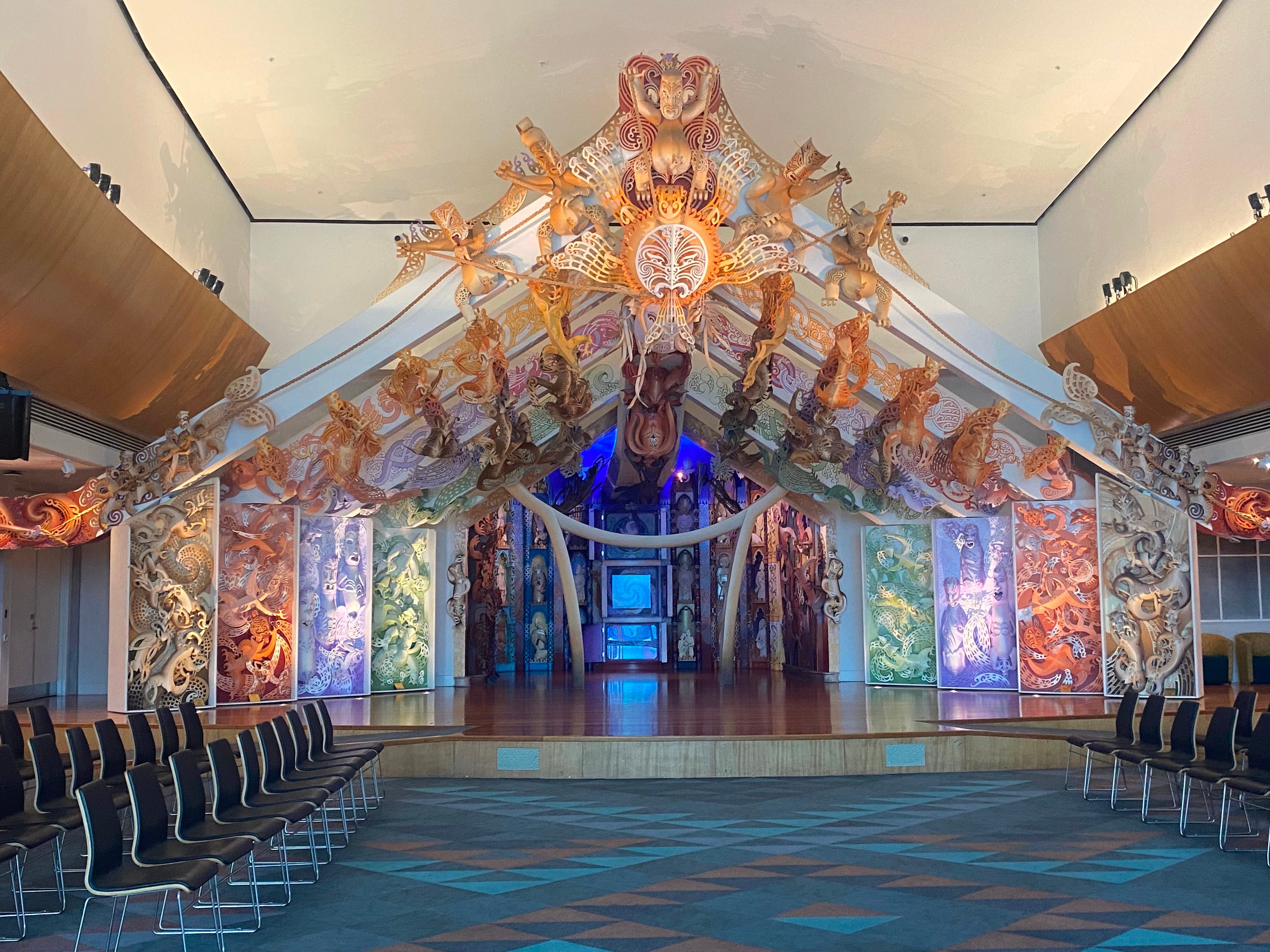
For our final outing in New Zealand, Neil took me to see the Te Papa Tongarewa Museum of New Zealand to see the collection of Māori art and artifacts. Perhaps the jewel of the collection is Te Marae. The space, designed by Māori artist Cliff Whiting, blends traditional Māori carving and design with contemporary materials and symbolism, Neil explained, creating a unique space where all people are invited to experience the richness and diversity of Māori culture.
A group of children aged about four to 12 scampered in play across the stage in front of Te Marae. Some of them then stopped at the front of the space, reciting words in te reo Māori. I watched as proud parents took photos and mouthed many of the words. Neil, too, silently recited with the children.
As we left, I asked Neil what the children had been saying. He told me that they were reciting their whakapapa—their genealogy—which, in Māori culture, may include both remembered human ancestors and ancestral connections to natural forces such as the sun, sea or sky. “These are not symbolic references but are part of a living worldview in which land, environment and spiritual ancestry are all woven into one’s identity,” Neil told me.
Near the entrance to the exhibit, a woman in a parka and jeans approached Neil. Some of the children in Te Marae were hers. She and Neil talked, the conversation becoming more and more animated. Soon they were exchanging phone numbers and emails. He told me later that they had never met before but had discovered that he had a friend in common with her younger brother and that her uncle had been his mentor in art school.
Wantok.
The Prompt
I told the writing group at OffCenter Community Arts about my recent experience in Aotearoa and how moving it was, connecting back to my earlier experiences in Papua New Guinea. I suggested they write about who shares your language, meaning, as Phil noted, your “posse.” It could be a person or group of people but could also be extended to animals, totems, places, a mythical figure.
We heard about the language of texting, about the vernacular of subcultures (like yachting). Another writer asked, “Who can speak fluently in broken heartedness?” From C.J., we heard about “threads of notes” while Joan shared that “I can make more sense listening to the birds this morning—a symphony of sound until a loud mowing machine comes by and when it leaves, there is silence. The birds have left.”
There’s also a special language in correctional facilities, prison slang or patois (a “bowl shot” is a meal made from commissary items; “elbow” is a life sentence). I even have a book on prison sign language, Deaf Culture Behind Bars: Signs and Stories of a Texas Population. Homeless people sometimes refer to “camping” and “campers” as those who prefer sleeping outdoors with or without tents. Online, I’ve found references to “getting rinsed” (robbed), “sniping” (looking for cigarettes) and “ground score” (finding something useful/valuable on the ground), all part of a homeless vernacular.
Who shares your language?