
Magic to Free the Subconscious

If you agree with British occultist Dion Fortune that magic is “the art of changing consciousness at will”1 and if you think of writing as magic (I do), then it makes sense to focus on harnessing the energy flowing through us when we first pick up a pen or begin a writing workshop.
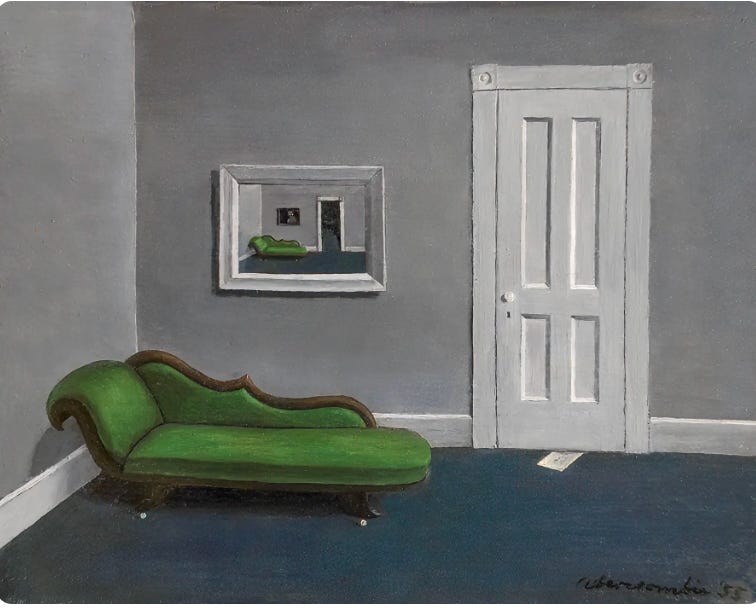
I am becoming ever more aware of the importance of an opening ritual. In jail, we read the 12 Steps of Creative Writing (written by the imprisoned writers themselves) at the beginning of each session. This was largely to calm a wild and unruly crowd and it (mostly) worked (Step Eight: “Don’t be going in and out, it’s disruptive;” see also Steps 5-7, 9 and 10).
Lately I’ve been harnessing visual art and writing games to help pry apart the gates of creativity. I wrote previously about “cloud tripping,” my term for an opening exercise of literally tracing images seen in random images of billows and puffs. One of the interesting (though I suppose unsurprising) things I noticed was that many of the splendidly crazy images found their way into that day’s prompt writing, to wit: God’s shaving cream and a hair cut talking to a ballerina.
A related exercise is what the Surrealists creatively name “Definitions” or “Questions and Answers”2. I tried this one at OffCenter Arts recently. One person wrote a question on the top half of a piece of paper, folded it over then gave it to the other person who wrote an answer without looking at the question. As the Surrealists promised, “[r]emarkable facts emerge[d].” Here are some of the results:
Q: What do trees dream about?
A: The road is crunchy with elm seeds and mulberry blossoms.
Q: What do you like about this time of year?
A: In the garden, among the tomatoes.
Q: What’s the weather like in your home?
A: I am mesmerized by the variety of life at the table.
Q: What are you looking forward to?
A: Love is always the answer to happiness.
And some friends of mine used the game at a recent dinner party with quite astonishing results:
Q: What is the answer to the universe?
A: Generations of Chinese have long pondered that question
Q: How many Norwegians does it take to change a lightbulb?
A: 3,472
Q: Divide 6 by 3 and then multiply the result by 10, what is the answer?
A: Because once in a while it just works out.
Q: How far is the moon?
A: As Buddha would say, the answer is non-attachment.
The Prompt
The above Q&A exercise is best done with a partner (you could try the exercise without one but that would require quite a bit of magical juice to pull off).
What may seem like simple warm-ups can grow into something more substantial.
Dion Fortune, The Training and Work of an Initiate, Rider & Co., 1930.
Alastair Brotchie (Ed. Mel Gooding), A Book of Surrealist Games, Shambhala, 1995.
I think they used to do this with drawings too, very cool.
I like Steven Pressfield’s use of The Invocation to the Muse from T. E. Lawrence’s translation of Homer’s Odyssey. He reads it every time he writes because he believes his writing comes through him.
Long, but I thought you’d enjoy it.
O divine Poesy!
Goddess, daughter of Zeus,
Sustain for me this song of the various-minded man,
who, after he had plundered the innermost citadel
of hallowed Troy, was made to stray grievously
about the coasts of men,
the sport of their customs, good and bad,
while his heart, through all the seafaring,
ached with an agony to redeem himself
and bring his company safe home.
Vain hope! For them! For his fellows he strove in vain.
By their own witlessness, they were cast aside.
To destroy for meat the oxen of the most exalted Sun,
wherefore the sun god blotted out the day of their return.
Make this tale live for us in all its many bearings, O Muse!